
| Line item | Year 1 | Year 2 | Year 3 | Year 4 | Year 5 |
|---|---|---|---|---|---|
| Revenue | $1,000,000.00 | $1,100,000.00 | $1,210,000.00 | $1,331,000.00 | $1,464,100.00 |
| EBITDA | $240,000.00 | $264,000.00 | $290,400.00 | $319,440.00 | $351,384.00 |
| NOPAT | $153,750.00 | $169,125.00 | $186,037.50 | $204,641.25 | $225,105.38 |
| Depreciation | $35,000.00 | $38,500.00 | $42,350.00 | $46,585.00 | $51,243.50 |
| Capital expenditure | $50,000.00 | $55,000.00 | $60,500.00 | $66,550.00 | $73,205.00 |
| Change in net working capital | $7,272.73 | $8,000.00 | $8,800.00 | $9,680.00 | $10,648.00 |
| Unlevered free cash flow | $131,477.27 | $144,625.00 | $159,087.50 | $174,996.25 | $192,495.88 |
| Discount factor | 0.92x | 0.84x | 0.77x | 0.71x | 0.65x |
| Present value of FCF | $120,579.87 | $121,644.25 | $122,718.04 | $123,801.30 | $124,894.12 |
| FCF check | $0.00 | $0.00 | $0.00 | $0.00 | $0.00 |
How does the DCF work?
(Cost of equity × equity weight) + (Pre-tax debt cost × (1 − tax rate) × debt weight)The cost of equity uses the risk-free rate plus beta times the equity risk premium. Set the direct WACC override to zero to use that transparent capital-cost build, or enter a non-zero override explicitly. Revenue and margin assumptions produce EBITDA; NOPAT plus depreciation less capital expenditure and change in net working capital produces unlevered free cash flow. The model calculates both Gordon-growth and exit-EBITDA-multiple terminal values, then uses the selected method for enterprise value. Net debt is deducted before dividing equity value by shares outstanding.
Worked base case
The sample builds WACC at 9.04%, produces $613,637.58 of present value from the explicit forecast, and calculates terminal values of $3,018,099.76 under Gordon growth and $2,811,072.00 under the exit multiple. With Gordon growth selected, value per share is $23.22.
Which assumptions should be sensitized?
WACC and terminal growth require a two-dimensional sensitivity because they interact in the Gordon-growth denominator. WACC and exit multiple should be tested separately for the market-multiple cross-check. Revenue growth, EBITDA margin, capex and working-capital investment form the operating cases. The workbook contains formula-driven valuation sensitivities rather than pasted outputs.
What does the model check?
- Unlevered FCF reconciles to NOPAT plus depreciation less capex and change in NWC.
- Built WACC reconciles to the visible equity and after-tax debt components.
- Both terminal methods calculate independently and the selected method feeds enterprise value.
- Enterprise value, equity value and value per share remain formula-driven; WACC must exceed terminal growth.
Limitations and failure states
This educational DCF uses one revenue-growth rate, one margin and annual end-of-period discounting. It omits detailed segments, dilution, tax attributes, leases, pensions and a mid-year convention. The exit multiple is a user assumption, not a market-data feed. DCF output is highly assumption-sensitive and is not an appraisal, fairness opinion or investment recommendation.
Actual workbook preview
See exactly what you will receive
These are direct renders of the delivered discounted cash flow model workbook—not a reconstructed mockup. Open any image to inspect the full-size sheet before requesting the file.
Change assumptions and scenarios without editing calculation cells.
Trace values pulled from assumptions and connected schedules.
Dedicated checks identify whether the workbook reconciles and where to investigate.
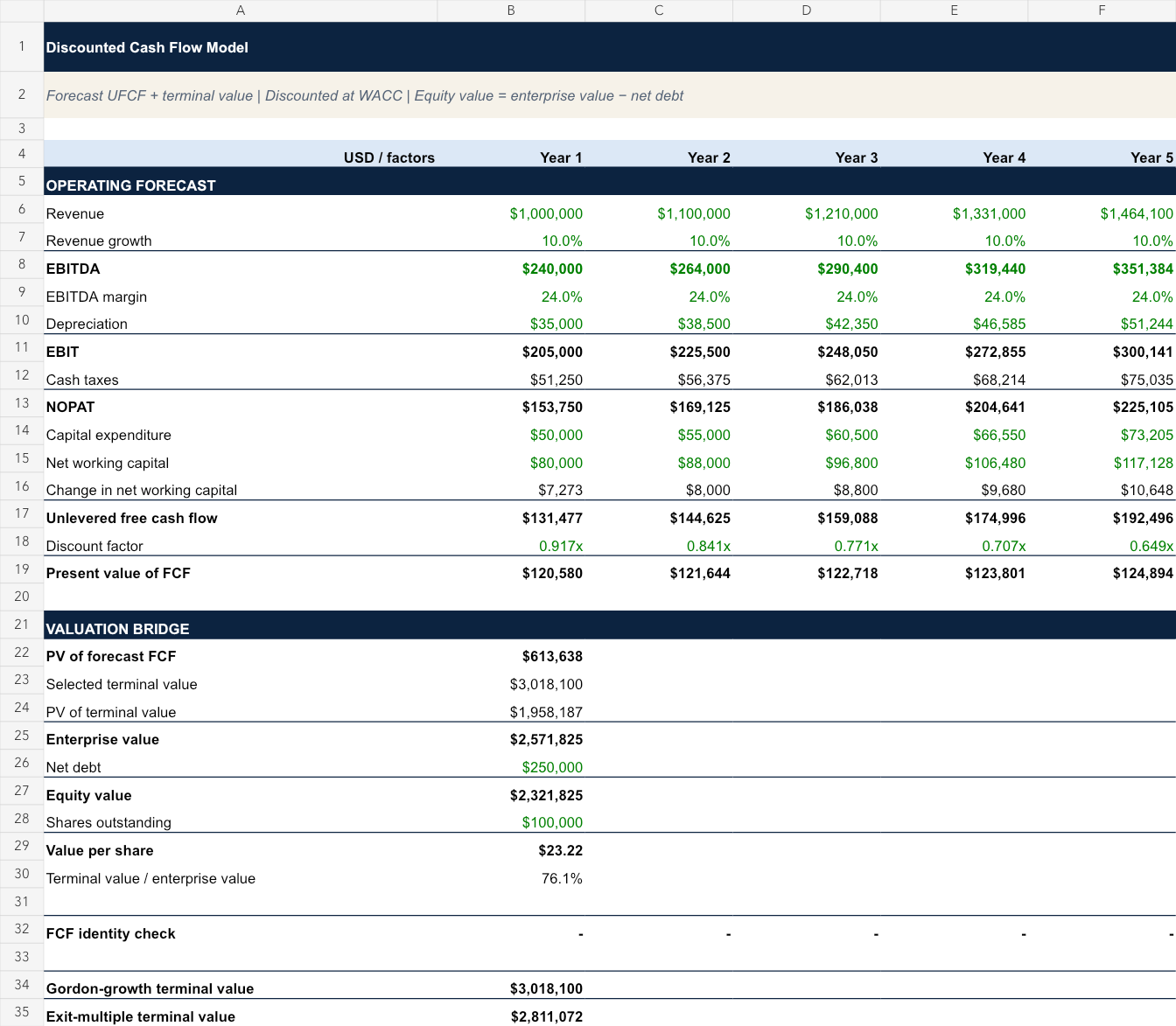
Look for: revenue through unlevered FCF, the present-value columns, terminal value, enterprise value, net debt and value per share.
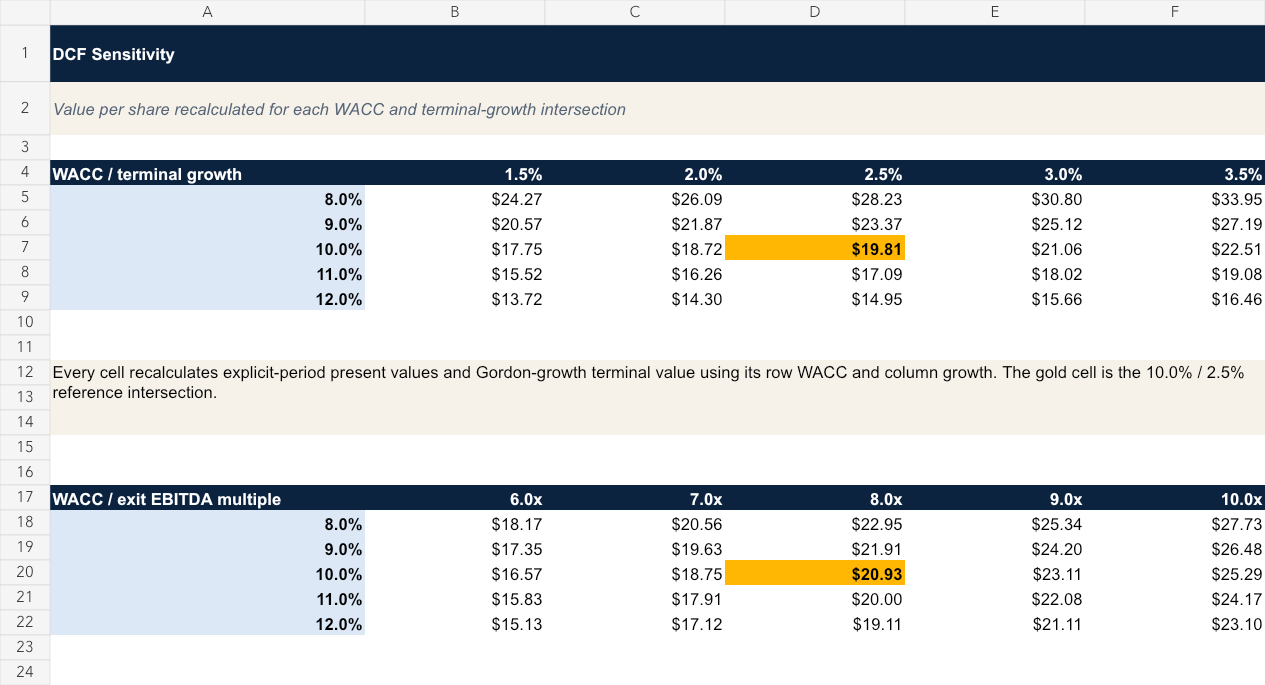
Look for: the central base-case cell and how every scenario recalculates the underlying forecast and terminal-value mechanics.
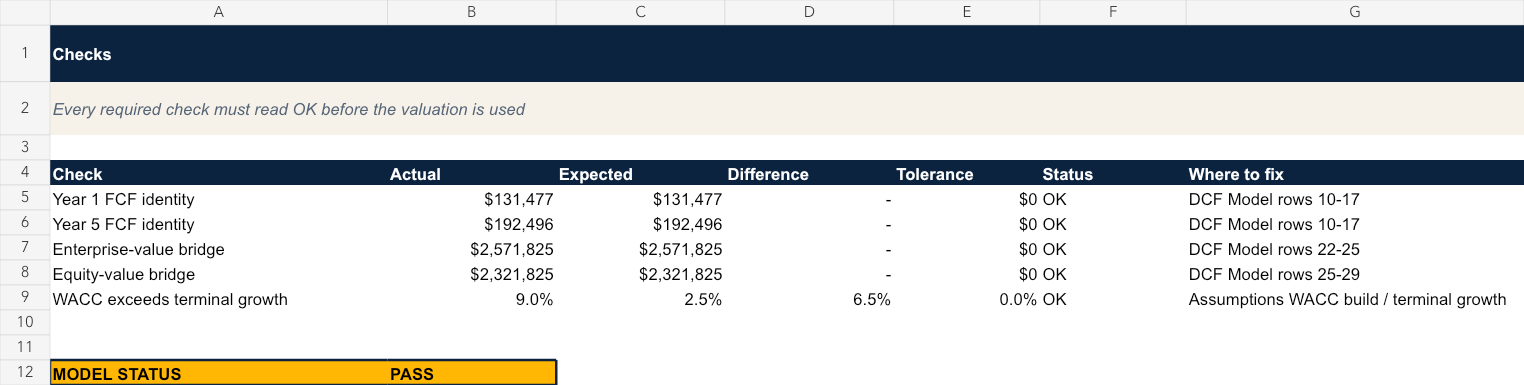
Look for: zero differences, explicit tolerances, PASS status and the location to fix when a control fails.
Included in the file
- Five-year unlevered free cash flow forecast
- Gordon-growth terminal value and present-value bridge
- Enterprise value, equity value and value per share
- Dynamic WACC and terminal-growth sensitivity
- Dedicated checks, conventions and source URLs
Free editable Excel workbook
Get the discounted cash flow model
The workbook is free and contains the exact model shown above: editable assumptions, linked formulas, checks and source notes.
The browser calculator above is free with no sign-up. Email is used only to deliver the workbook; marketing permission is separate and optional.
Sources, version and review status
Valuation definitions are checked against Professor Aswath Damodaran’s financial definitions; spreadsheet discounting mechanics are checked against NPV function. Version 1.0 was last checked on 2026-08-26. Methodology review is complete; no named external expert reviewer is claimed.
Related models and formulas
Frequently asked questions
What is discounted cash flow model?
A discounted cash flow model estimates enterprise value from the present value of forecast unlevered free cash flow and a discounted terminal value, then bridges to equity value.
How should I use discounted cash flow model?
Use the formula only after matching every input to the same period, unit and definition. Then compare the result with a worked example and the decision you are trying to make.
What is the most common mistake with discounted cash flow model?
The most common mistake is using a terminal growth rate at or above WACC or mixing levered cash flow with an enterprise-value discount rate.
Can I calculate discounted cash flow model in a spreadsheet?
Yes. Reproduce the displayed equation with separate cells for each input, keep percentages as decimals, and test the spreadsheet against the worked example before replacing the sample figures.