
| Line item | Week 1 | Week 2 | Week 3 | Week 4 | Week 5 | Week 6 | Week 7 | Week 8 | Week 9 | Week 10 | Week 11 | Week 12 | Week 13 |
|---|---|---|---|---|---|---|---|---|---|---|---|---|---|
| Opening cash | $150,000.00 | $144,500.00 | $139,850.00 | $136,058.50 | $133,134.09 | $131,085.43 | $129,921.28 | $129,650.49 | $130,282.00 | $131,824.82 | $134,288.07 | $137,680.95 | $142,012.76 |
| Cash receipts | $85,000.00 | $85,850.00 | $86,708.50 | $87,575.59 | $88,451.34 | $89,335.85 | $90,229.21 | $91,131.50 | $92,042.82 | $92,963.25 | $93,892.88 | $94,831.81 | $95,780.13 |
| Total disbursements | $90,500.00 | $90,500.00 | $90,500.00 | $90,500.00 | $90,500.00 | $90,500.00 | $90,500.00 | $90,500.00 | $90,500.00 | $90,500.00 | $90,500.00 | $90,500.00 | $90,500.00 |
| Net cash before financing | -$5,500.00 | -$4,650.00 | -$3,791.50 | -$2,924.41 | -$2,048.66 | -$1,164.15 | -$270.79 | $631.50 | $1,542.82 | $2,463.25 | $3,392.88 | $4,331.81 | $5,280.13 |
| Revolver draw | $0.00 | $0.00 | $0.00 | $0.00 | $0.00 | $0.00 | $0.00 | $0.00 | $0.00 | $0.00 | $0.00 | $0.00 | $0.00 |
| Revolver repayment | $0.00 | $0.00 | $0.00 | $0.00 | $0.00 | $0.00 | $0.00 | $0.00 | $0.00 | $0.00 | $0.00 | $0.00 | $0.00 |
| Ending cash | $144,500.00 | $139,850.00 | $136,058.50 | $133,134.09 | $131,085.43 | $129,921.28 | $129,650.49 | $130,282.00 | $131,824.82 | $134,288.07 | $137,680.95 | $142,012.76 | $147,292.88 |
| Closing revolver | $0.00 | $0.00 | $0.00 | $0.00 | $0.00 | $0.00 | $0.00 | $0.00 | $0.00 | $0.00 | $0.00 | $0.00 | $0.00 |
| Total liquidity | $394,500.00 | $389,850.00 | $386,058.50 | $383,134.09 | $381,085.43 | $379,921.28 | $379,650.49 | $380,282.00 | $381,824.82 | $384,288.07 | $387,680.95 | $392,012.76 | $397,292.88 |
| Minimum-cash headroom | $44,500.00 | $39,850.00 | $36,058.50 | $33,134.09 | $31,085.43 | $29,921.28 | $29,650.49 | $30,282.00 | $31,824.82 | $34,288.07 | $37,680.95 | $42,012.76 | $47,292.88 |
| Cash check | $0.00 | $0.00 | $0.00 | $0.00 | $0.00 | $0.00 | $0.00 | $0.00 | $0.00 | $0.00 | $0.00 | $0.00 | $0.00 |
How does the 13-week forecast work?
Opening cash + receipts − disbursements + revolver draw − revolver repaymentThe model uses the direct method: it forecasts when cash enters and leaves rather than starting from accounting profit. Recurring payroll, supplier, occupancy, operating, capital and debt-service payments are shown separately. A financing waterfall draws only enough revolver to support the minimum cash balance and repays borrowings when excess cash is available.
Worked base case
The sample starts with $150,000.00 of cash and $250,000.00 of revolver capacity. Week 1 receipts are $85,000.00, disbursements are $90,500.00, and cash closes at $144,500.00. Minimum liquidity across all thirteen weeks is $379,650.49.
How does the funding waterfall work?
When pre-financing cash falls below the minimum, the model draws the lesser of the funding gap and unused commitment. When pre-financing cash exceeds the minimum, it repays the lesser of available excess cash and outstanding revolver. If the commitment cannot restore minimum cash, the negative headroom remains visible as an unresolved funding need.
What does the forecast check?
- Ending cash reconciles to opening cash, operating movement and financing.
- The revolver never exceeds its stated commitment or falls below zero.
- Total liquidity equals ending cash plus unused revolver capacity.
- Minimum-cash headroom exposes any unresolved funding gap.
Limitations and failure states
This educational model uses recurring weekly payments and a smooth receipts ramp. It does not include invoice-level collection dates, payroll calendars, tax-payment dates, one-time restructuring items, lender fees, interest on the revolver or covenant definitions. A real 13-week cash forecast should be refreshed with actual bank and accounts-receivable data every week.
Actual workbook preview
See exactly what you will receive
These are direct renders of the delivered 13-week cash flow forecast workbook—not a reconstructed mockup. Open any image to inspect the full-size sheet before requesting the file.
Change assumptions and scenarios without editing calculation cells.
Trace values pulled from assumptions and connected schedules.
Dedicated checks identify whether the workbook reconciles and where to investigate.
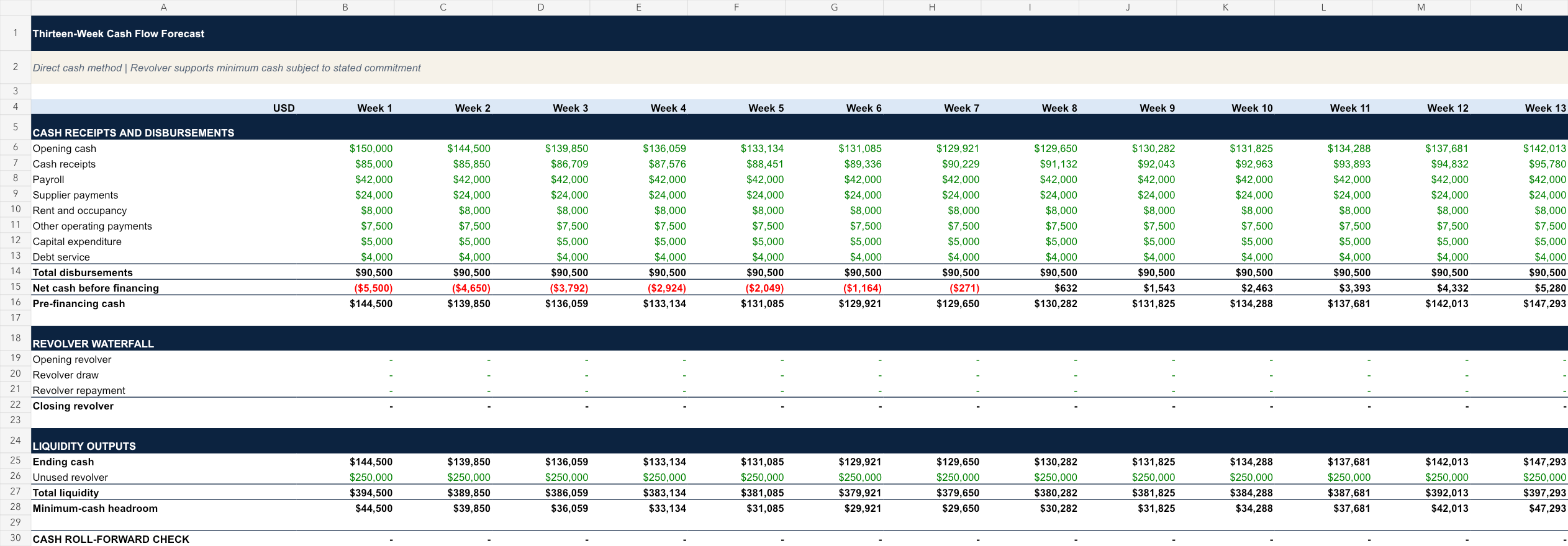
Look for: opening cash, direct cash receipts, each payment category, the financing waterfall, ending cash and total liquidity.
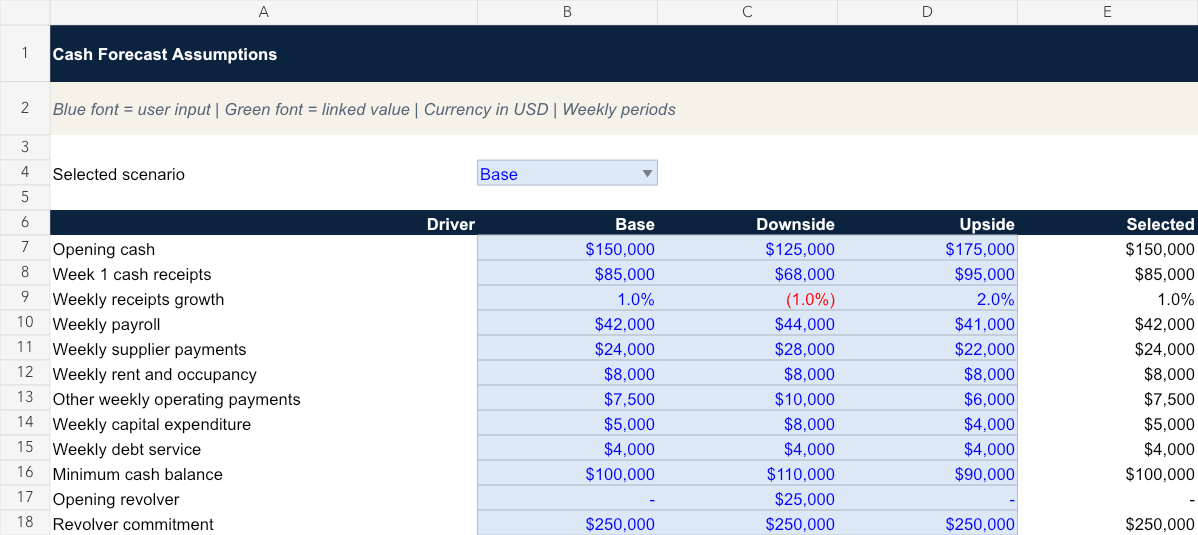
Look for: blue inputs for the receipt ramp, recurring payment categories, minimum cash policy and credit capacity.
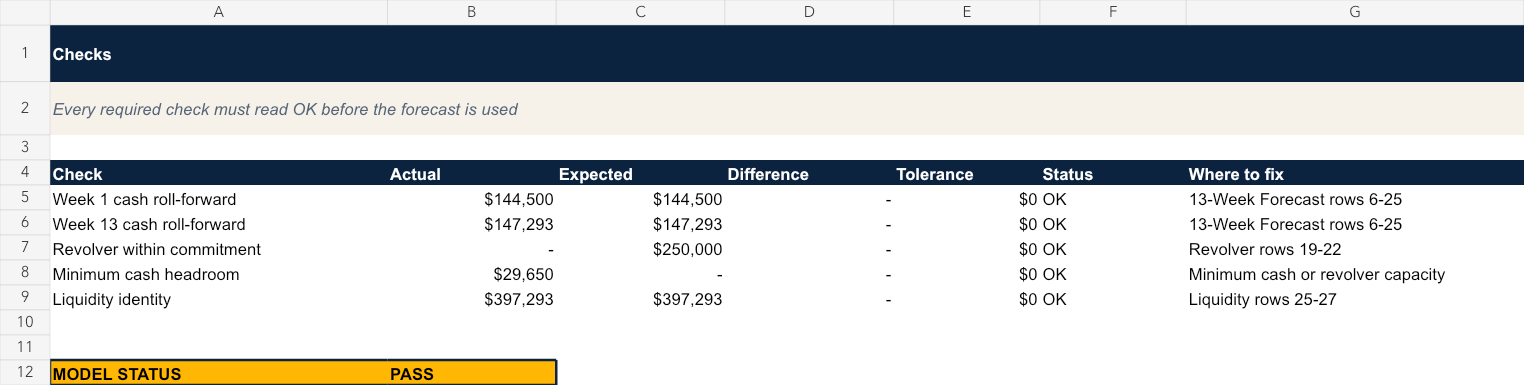
Look for: zero cash differences, the maximum revolver versus commitment, minimum liquidity and PASS status.
Included in the file
- Thirteen-week direct cash receipts and disbursements
- Minimum-cash and revolver draw/repayment waterfall
- Ending cash, unused capacity and total liquidity
- Base, downside and upside operating assumptions
- Dedicated cash and credit-capacity controls
Free editable Excel workbook
Get the 13-week cash flow forecast
The workbook is free and contains the exact model shown above: editable assumptions, linked formulas, checks and source notes.
The browser calculator above is free with no sign-up. Email is used only to deliver the workbook; marketing permission is separate and optional.
Sources, version and review status
Cash-flow statement context is checked against Beginners’ Guide to Financial Statements; forecast mechanics follow the site’s period, sign and reconciliation conventions. Version 1.0 was last checked on 2026-08-26. All figures are illustrative; no named external expert reviewer is claimed.
Related models and formulas
Frequently asked questions
What is cash flow forecast?
A cash flow forecast estimates the timing of cash receipts and disbursements, then rolls opening cash through financing activity to ending cash and available liquidity.
How should I use cash flow forecast?
Use the formula only after matching every input to the same period, unit and definition. Then compare the result with a worked example and the decision you are trying to make.
What is the most common mistake with cash flow forecast?
The most common mistake is treating income-statement revenue and expense recognition as if it were the same as cash collection and payment timing.
Can I calculate cash flow forecast in a spreadsheet?
Yes. Reproduce the displayed equation with separate cells for each input, keep percentages as decimals, and test the spreadsheet against the worked example before replacing the sample figures.